WATCH: Unionized Workers at Cornell May Strike At Start of Fall Semester
"We're taking the same approach that we we took with the Stand Up Strike with the Big Three auto plants," explained Wence Valentin III, political director for UAW Region 9, referring to historical wins that the union secured for auto workers last November.
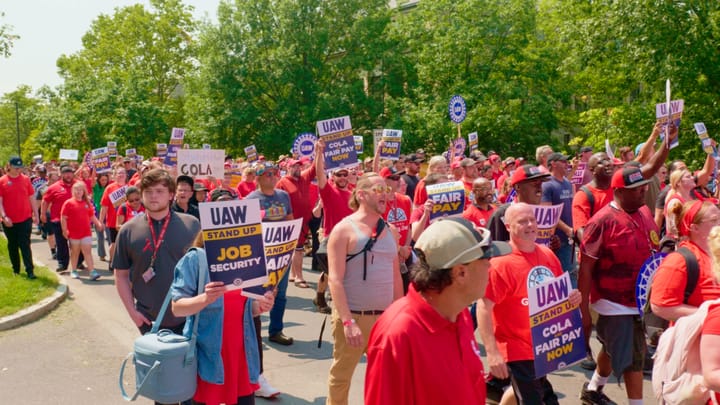
On Friday, August 2, five union representatives from UAW Region 9 visited Ithaca, from their office in Buffalo, NY. UAW Region 9 represents New York, New Jersey, and Pennsylvania, and the representatives stated that the goal of their visit was to build community and political support for the local bargaining unit of the international union. They also wanted to communicate to Cornell that this contact negotiation would be different from previous negotiations between the university and the union.
"I'm here today in my capacity and my role to try to start ratcheting up the pressure," said Daniel Vicente, UAW Region 9 director, in an interview at a rally outside the Tang Welcome Center on Cornell's campus on Friday. "I'm the guy that would sign the strike authorization for this unit, and I'm already ready to rock," explained Vicente. "We don't want to go there, but [Cornell sets] the tone at the table," he said hammering the point that he felt Cornell was unwilling to budge on a number of issues of importance to members of UAW Local 2300, which could result in a strike. Vicente characterized the university's proposals during the negotiations as "insulting".
Approximately 1,200 workers employed by Cornell University are members of UAW Local 2300— workers who make up Cornell's Service and Maintenance Unit. The lion's share of these employees work in building care (custodial workers) and for Cornell dining. However, the union membership contains a range of other job titles which can be found in the recently-expired contract between the union and the university (page 92 onward).
"We've been very clear that the 18th is the deadline," said Lonnie Everett, international servicing representative with UAW Region 9 who is leading the negotiations, on the union side, with Christine Johnson, president of UAW Local 2300. "What happens on, or after the 18th is left up to Cornell."
"We're taking the same approach that we we took with the Stand Up Strike with the Big Three auto plants," explained Wence Valentin III, political director for UAW Region 9, referring to historical wins that the union secured for auto workers last November.
"We're trying to take that to every location that we have in the UAW," said Valentin about the union's strategy, explaining that the union would be fighting harder for workers during contract negotiations than it had in the past.
UAW played hardball during negotiations with the automakers General Motors, Ford and Stellantis, eventually calling for tens of thousands of workers to strike in September and October 2023. The pressure resulted in significant wage increases, among other improved conditions and benefits for workers.
Increased Transparency
"We want to continue down the path that we're we've already started," said Everett. "Which is to be transparent about our negotiations, to lay out not just to the employer, but also lay out to the membership, what we're expecting."
Vicente and the other union officials wanted to dispel the notion, "that we're negotiating how we used to negotiate, which was go behind closed doors for a month or two, don't talk to the membership, don't engage the rank and file workers, and then come out and tell the workers that this was the best that we could do."
The shift in tactics and increase in transparency in the union came after a leadership shakeup in March 2023, when the current president of UAW, Shawn Fain won UAW's first democratic election, offering hope for the membership that leadership would move away from its insular and sometimes corrupt past years.

Financial Strain on Workers and COLA
Among the chief concerns that brought workers to the rally was the increased cost of living, and the fact that wages have not matched increased food and housing costs. One sticking point between the union and the university has been COLA, or a cost of living adjustment. A COLA provision in the contract would require Cornell to increase worker pay relative to inflation in the economy.
"Over the years, you know, it seems as if our paycheck does not go as far," said Louise Braron, a custodial building care worker who was at the rally. "You notice it year to year. We can tell just going grocery shopping that we don't buy the foods we once used to buy because we can't afford them any longer."
"You can't afford certain things downtown, if you can't even get paid properly," said another custodial worker, Brian Vance, explaining that if worker pay went up, residents like him would be able to spend more in Ithaca when going shopping. "Especially a great college like Cornell... I really feel like they could do better by us."
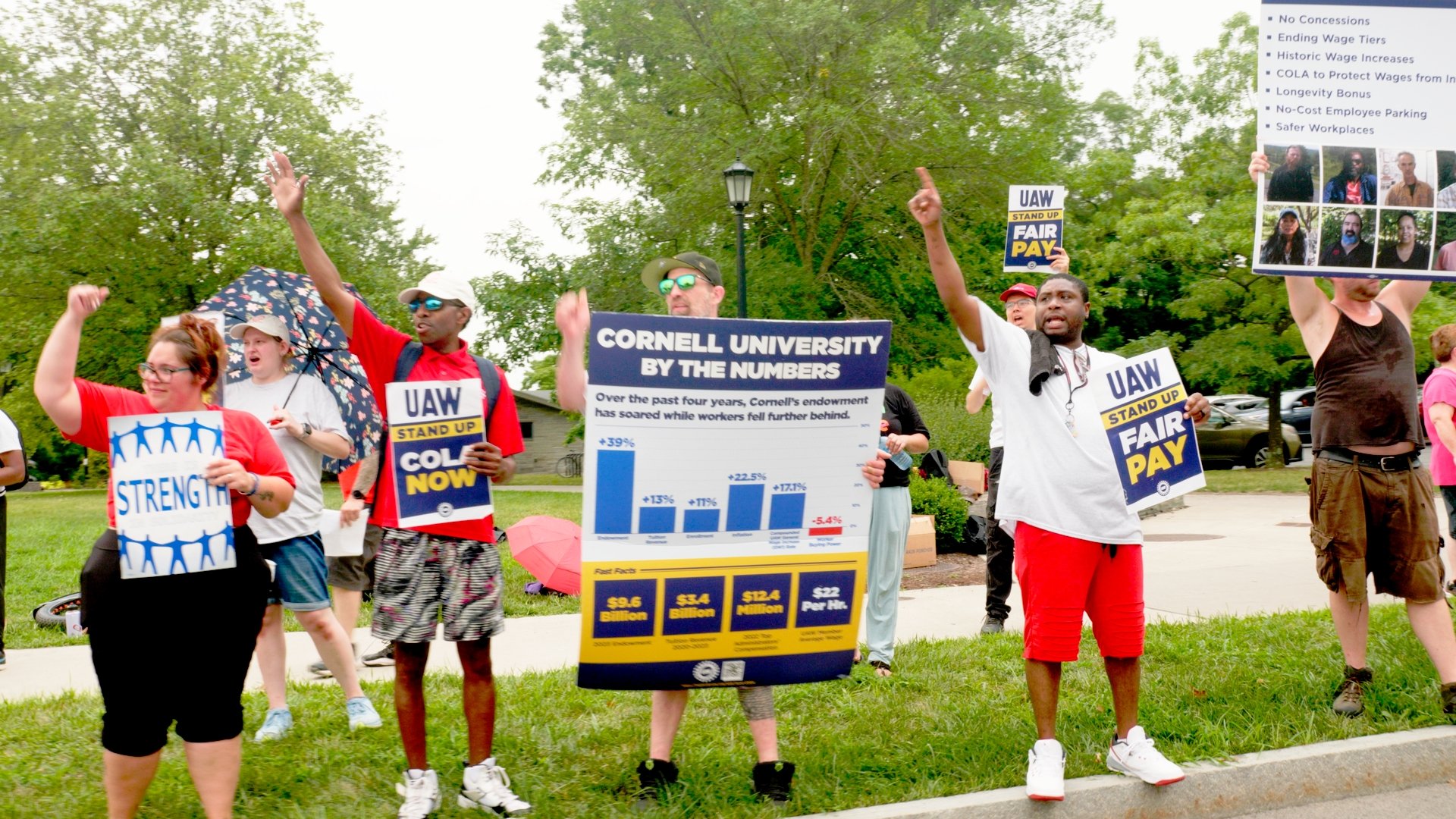
Other issues that were centered by both workers and union representatives was the fact that workers must pay for parking when working at Cornell, something the union membership wants to do away with. "You make your employees pay for the parking, you pay them, and then you take the money back in the cost of the parking itself," said Everett, explaining that "Cornell was a 'No' on eliminating the cost to employees to pay for parking."
Another point of contention is the tiered pay system, in which workers hired before a certain date. "People doing the same job and getting paid less money is not the business," said Everett. "Cornell's response to that? No movement on the tiers."
"If there's one thing I can ask of you and ask of anybody who's out there, stand behind these members here," said Everett. "If you're a member who's sitting on the sidelines, let's get out here and start giving them the support that they need so that you can get the historic contract of a lifetime."
"If people want to come and walk with us show that support, we would certainly appreciate it," said Valentin, inviting the community to join the rallies. "You could see any one of us, and we can educate you on why we're out here taking these actions, and why we're taking Cornell to task and we're asking them to give our workers the pay that they deserve."